Through the Oderbruch
Day 23 — On the train — April 18, 2026
The outskirts of Frankfurt (Oder) first. The city releasing you from the back — the industrial edge, the side of a place you never see when you arrive.
Then Lebus. The bluffs above the Oder. The valley opening. The river below, wide and slow. I have ridden that ridge. The body knows the gradient before the window shows it.
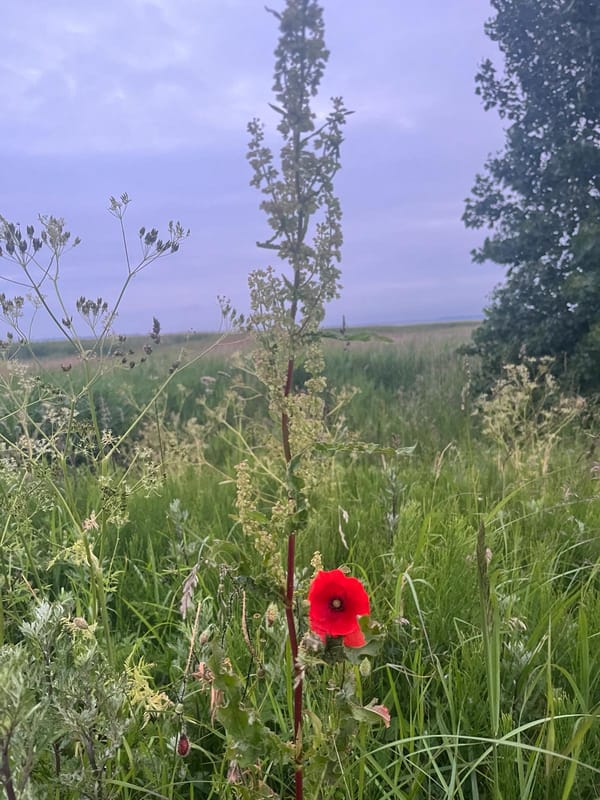
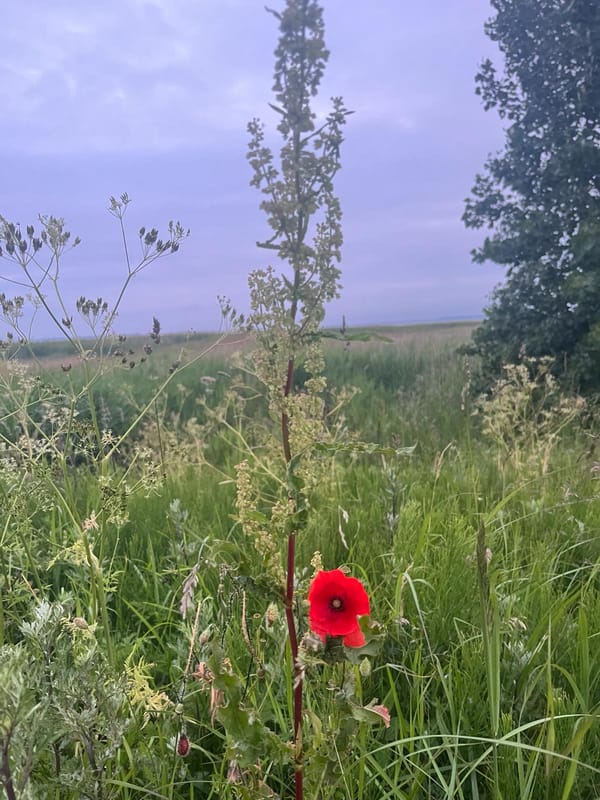
Then the Oderbruch — the flat reclaimed land, the enormous sky, the horizon unbroken in every direction. No resistance. No effort. The plain moving past the glass.
I have travelled this landscape by bicycle many times in thirty-one years. The body holds it — the wind out of the east, the particular quality of the light, the villages in sequence. The train carries me through it differently. The same ground. A different knowing.
In April 1945, Soviet forces crossed the Oder here — fiercely, at tremendous cost — and took the Seelower Höhen above Lebus in some of the bloodiest fighting of the final weeks of the war. Then down into the Oderbruch below. The same fields, the same sky.
The land does not say anything about this. It holds it the way it holds everything — without comment, without ceremony. The reeds grow. The drainage ditches run. The horizon stays where it is.
Underneath it all, bones still waiting to be found. Still waiting to be heard. Soviet and German alike.
The pilgrimage I am on began with a question: what does a landscape carry? At Gut Nisdorf, the Funnelbeaker tomb-builders, the Nordic Bronze Age peoples, the Rani of Rügen — five thousand years of human attention deposited in the ground of the Baltic coast. The pilgrim enters that field and is changed by what it holds.
The Oderbruch is a different kind of accumulated field. The wound is only eighty-one years deep. The bones are still near the surface. I have ridden my bicycle over this ground thirty-one years without always naming what lay beneath.
The same question. A different ground. Can you be present to what is here — not only what is visible?
Eighty-one years later, a pilgrim on a train going north.
This landscape means something to me. It has meant something for thirty-one years, most of it unnamed. It means something to the generations that come after — not as a wound to carry, but as a ground to remember. To not forget. To build something better on.
The ground carries what it carries.