The Peace Train
Wake-up feel: 7.
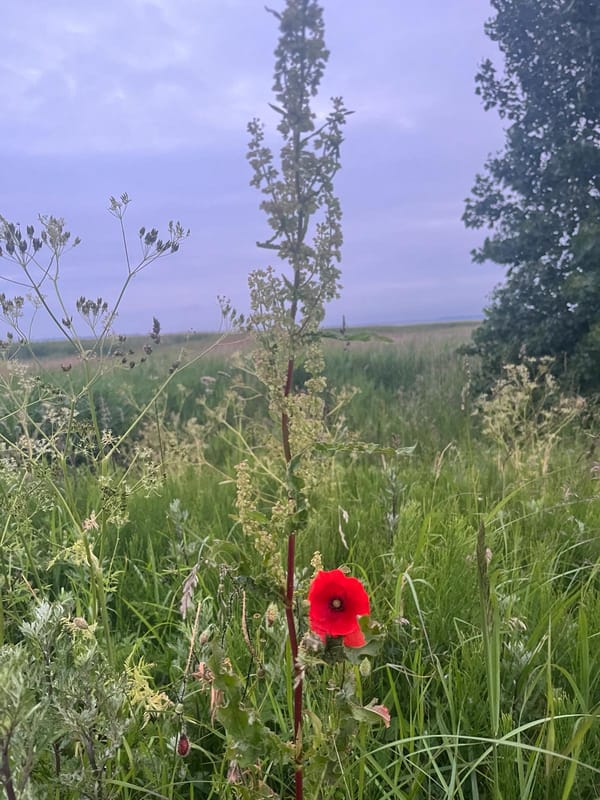
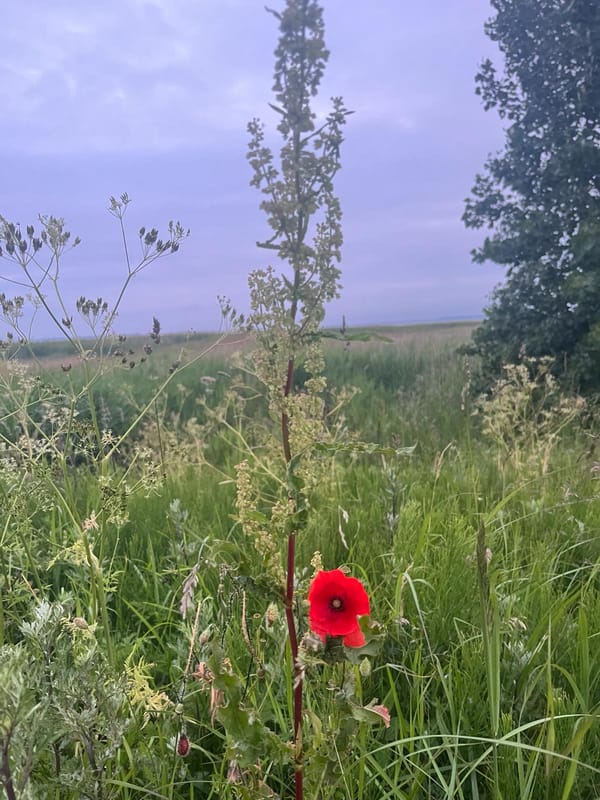
Up at 4:25. Rain came through the night — by morning it had washed everything. The dust from yesterday gone. The rapeseed held its scent to the right of the winding road; the Bodden and the reed fields to the left, the water's surface smoothed.
At the threshold to the pathway, the magpie was on the tip of the rooftop. Silent. Not alarmed. Watching.
No engine this morning. The fisherman who goes out before first light — the one named back in early May, the one who was here before this pilgrimage began and will be here after it closes — was not audible. The Bodden held the silence.
The big black bird was there again, flying along the coastline over the reed fields. Gliding, no call. At the turnaround, in the field to the right — rising mist, low and soft. One deer. Two. Three. Standing in it. No barking this morning. They moved slowly. I turned back toward Gut Nisdorf.
Fifty-six mornings on this road. Going out: the Bodden and the reed fields to the left, the rapeseed and the rising sun to the right. Coming back: reversed. Two landscapes. Two worlds. One road between them. The peoples who walked this coast before written memory knew it as liminal ground — where the dead and the living are not yet separated.
Four days ago, the bees swarmed. Yesterday, a rainbow formed over the Bodden. Last night, the rain came through. This morning, the dust is gone.
Moon in Cancer. Leaf day — what circulates between the stored and the expressed.
This is Day 56 of a pilgrimage. Fifty-six days at Gut Nisdorf on the Baltic coast of Mecklenburg-Vorpommern — working the ground, walking the question. The question has been the same since the beginning: what kind of presence is still possible, and where.
Not a programme. Not an organisation. Not a project in the sense of a proposal with a budget line and a reporting framework. A practice. A discipline. The kind that begins wherever the door opens and continues as long as the ground can hold it.
The Peace Train.
You do not choose peace as a subject. You arrive at it — usually because something broke, and you had to learn what holds.
Peace is not planted. It is composted.
Planting requires prepared ground, a controlled condition, a known outcome. Composting works with what is already present — the waste, the broken-down, the material that has not yet found its form. Given time, given turning, given the right conditions of warmth and moisture and microbial patience, it becomes something that feeds everything that grows in it.
A family, a community building its ground back after war is not planting peace. It is composting it. Slowly. From what is already there.
The same is true at the kitchen table.
Peace moves in both directions. This is what the pilgrimage has been learning — not as theory but as a physical fact, walked into the body over fifty-six days.
From the family's kitchen table to the community. From the community to something larger. And back again — from the larger ground to the community, from the community to the table where the ordinary Tuesday happens.
The middle layer is always the community. Small enough to know itself. Working on something that matters. Ground held in common.
Without the middle layer, the kitchen table and the treaty table do not speak to each other. The Peace Train moves in that space — not toward a destination, but between the scales. Showing up. Working alongside. Building WITH.
It does not bring solutions.
It brings the discipline of showing up.
From May 25 to 30 I will be in Müllrose. I want time with the children I love — Julika, Mattheo, Sini, Jacqueline and Denise, as well as my grandchild Emma. Not to tell them what I have decided. I want to know and understand where they are in their lives. To ask what they need from me, as a father. Also to understand what it means to be their father from wherever I land. I also want to know if the lock is still on the bridge, if there is a place for me at the kitchen table on a normal Tuesday. All this before I make my final decision known — to leave or not to leave on June 11 to a place where one door is already open, with people on the other side, willing, waiting. A place where I am needed. I am expected to arrive on the 21st of June, with no known date of return.
Three deer in the mist. No barking.
Seven places were on the table. Now three. I am not naming them yet. What I am naming is what I need from wherever I land.
Day 56 — Phase 8 — The Peace Train — Kidney — Agate — Durga
Gut Nisdorf, Mecklenburg-Vorpommern, Baltic Coast
© 2025–2026 Michel Garand | A Pilgrim's Fitness Plan | CC BY-SA 4.0
stewardship@ubec.network