The Man at the Bottom of the Lake
Day 27 — Phase 4 — Balance — Gut Nisdorf
Wake-up feel: 6. Up at 5. An article. A wild man lives at the bottom of a lake, locked in a cage.
Robert Bly tracked this image across mythologies and across cultures. Jung studied the same figure.
Flower day. Moon in Gemini. The day moves upward. What is below the surface becomes visible when the light is right. The day moves upward. What is below the surface becomes visible when the light is right.
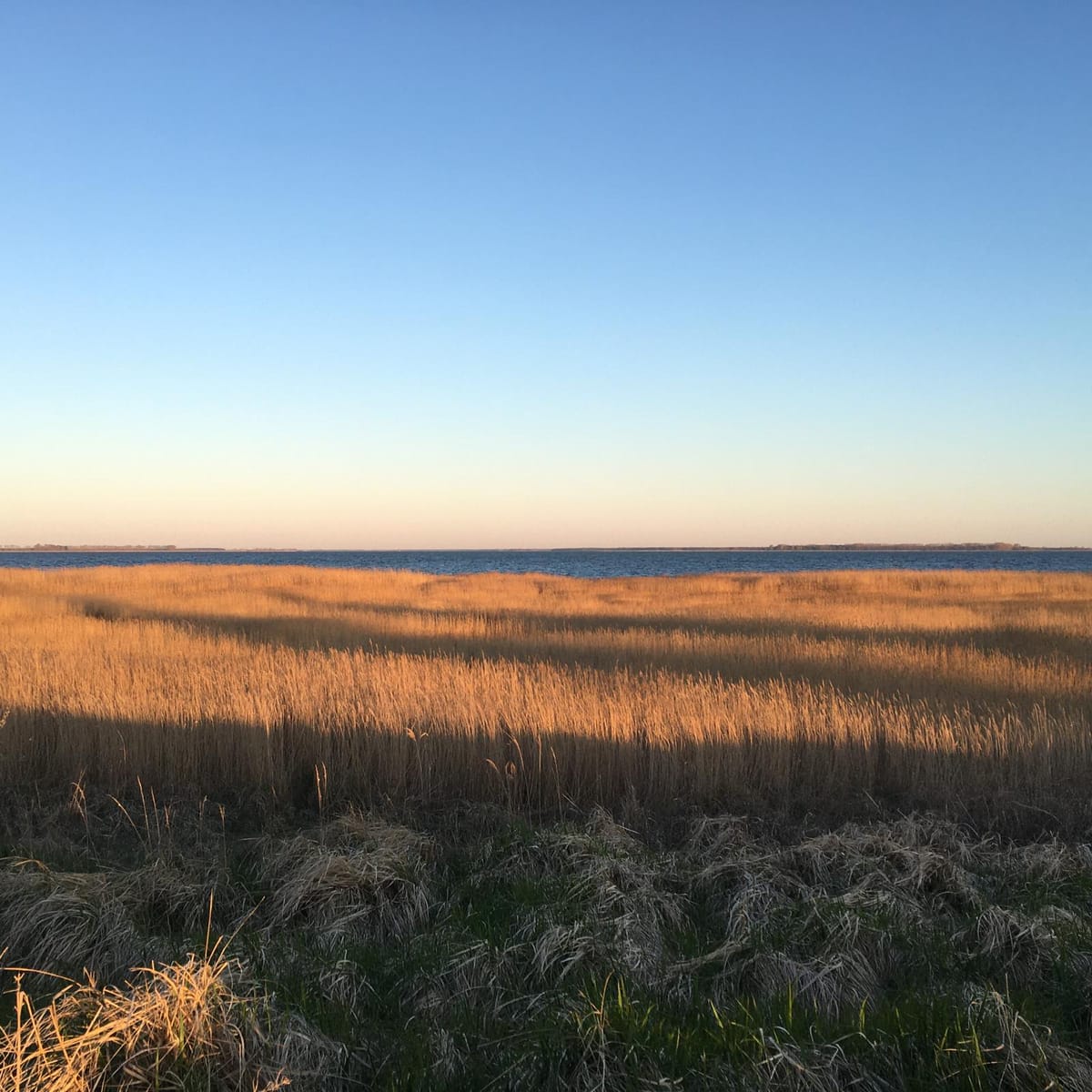
The winding road. Bodden to the left, reed fields catching the first light. Rapeseed to the right, the rising sun behind it.
I walked with the question: was there a man at the bottom of the lagoon, locked in a cage?
At the far point of the road I turned. Stood still. Listened.
Six swans lifted off the water and flew south. Last time there were seven.
The Bodden is not a metaphor. A coastal lagoon — brackish, held between the Baltic and the shore, neither fully sea nor fully land. In the Baltic and Slavic traditions, the water spirit belongs to specific water. Not water in general. This crossing. This shallow. Fishermen on this coast knew which water was his and made offerings at the edge.
Five thousand years of people standing here, reading this water.
The wild man in the Grimm tale is found at the bottom of a pond at the edge of a dark forest. The king's hunters disappear into that forest one by one before anyone drains the water and finds him.
Tomorrow I go looking.
In Bly's telling, the wild man is not the monster. He is caged power — recovered only when a boy loses something precious near the bars. The key is under the mother's pillow. Not in the king's keeping.
The key is not in my hands yet.
Gut Nisdorf, Mecklenburg-Vorpommern. April 22, 2026.
© 2025–2026 Michel Garand | CC BY-SA 4.0 | stewardship@ubec.network
A Pilgrim's Fitness Plan — Gut Nisdorf 2026