The Seven Essential Needs
Mike Sosteric — A Framework for Human Flourishing
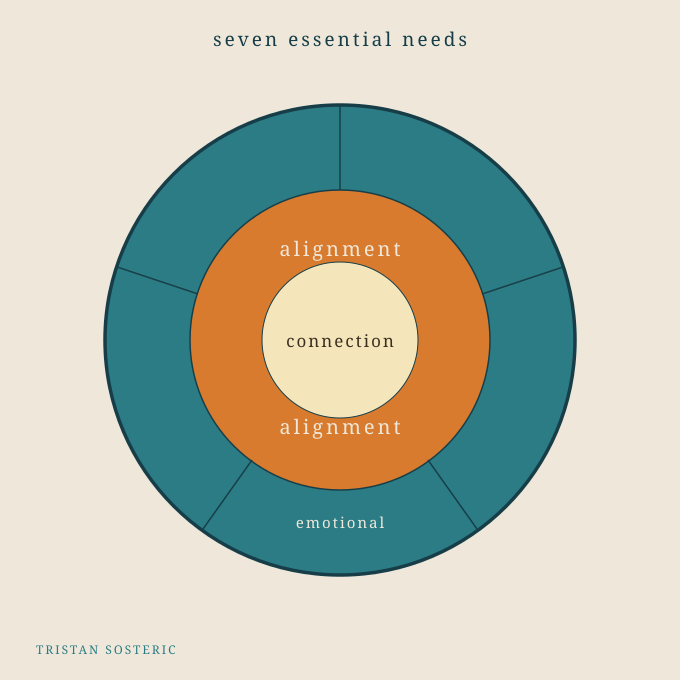
Abraham Maslow proposed his hierarchy of needs in 1943 — five categories arranged in a pyramid: physiological, safety, love, esteem, and self-actualisation. The pyramid became one of the most reproduced diagrams in psychology. It also became one of the most misread.
Maslow had a second hierarchy — cognitive needs — that rarely appeared alongside the first. He was also developing a broader theory of human flourishing, what he called Eupsychian theory, before his death in 1970. The pyramid, stripped of this wider context, became a tool for justifying scarcity thinking: meet the bottom levels first, then worry about the rest.
Mike Sosteric, sociologist at Athabasca University, reclaims the fuller Maslow. He collapses both hierarchies into a single circle of seven essential needs — not a pyramid, not a ranking, but a matrix. All seven are active across a human life. Unmet needs do not disappear; they become the ground for manipulation, atrophy, and what Sosteric calls Toxic Existence.
The seven needs, in two categories:
Outer needs — the conditions the body requires from its environment:
Physiological — food, water, air, shelter, movement, sex. The body's basic metabolism with the world. Sex belongs in this tier not because abstinence kills, but because the biological drive is hardwired — generated by the body without being asked. Chronic unmet sexual need produces measurable physiological and psychological effects. Maslow included it in his original 1943 paper. Later versions of the pyramid quietly removed it. Sosteric restores it.
Safety and stability — physical security, financial stability, environments free of chronic threat. The body cannot develop under sustained danger.
Love and attachment — unconditional love, belonging, connection to family, community, and society. Not sentiment. Structural requirement.
Truth — the need to know and understand the world accurately. To be lied to systematically is to be harmed at the cognitive level.
Self-esteem and efficacy — the need to feel capable, recognised, and effective in the world. Not pride. The grounded sense that one's presence and actions have weight.
Inner needs — the conditions the self requires from within:
Alignment — the need to live in correspondence with one's own deepest nature. To express who one actually is. What Aristotle called eudaimonia — not happiness as mood, but excellence as practice.
Connection — the need for contact with something larger than the constructed self. Variously named: transcendence, the sacred, the ground of being. The need that the other six make possible.
Sosteric's key departure from Maslow: the needs are not a ladder. They are a circle. All seven are present from the beginning. The work of a life is not to climb from one to the next but to fill in the gaps — wherever the conditions of one's particular history have left them unmet.
This framework ran through the needs series published in this blog across Days 38–45. The question was never which place to choose. The question was what any place must provide.
Source: Sosteric, M. Eupsychian Theory I: Reclaiming Maslow and Rejecting the Pyramid — The Seven Essential Needs. Athens Journal of Psychology, 2020. Licensed for educational use.
A Pilgrim's Fitness Plan — Gut Nisdorf 2026
© 2025–2026 Michel Garand | CC BY-SA 4.0
stewardship@ubec.network