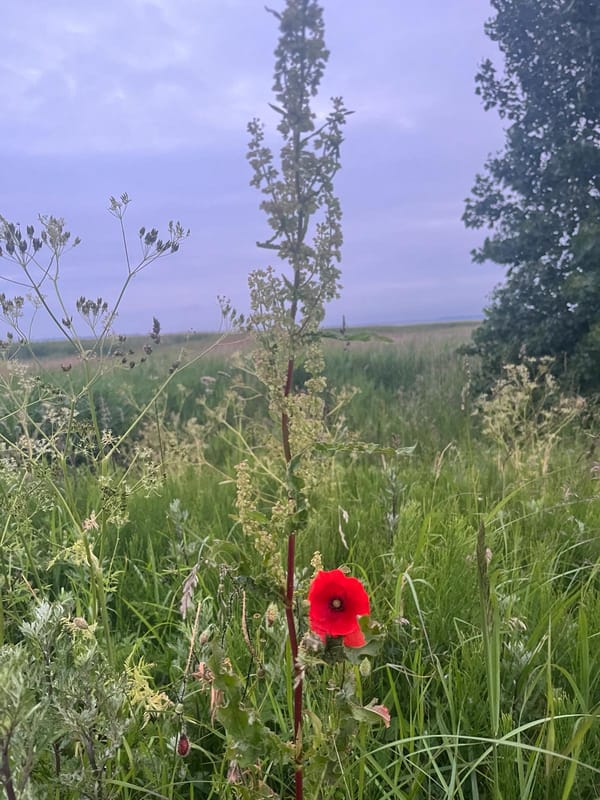
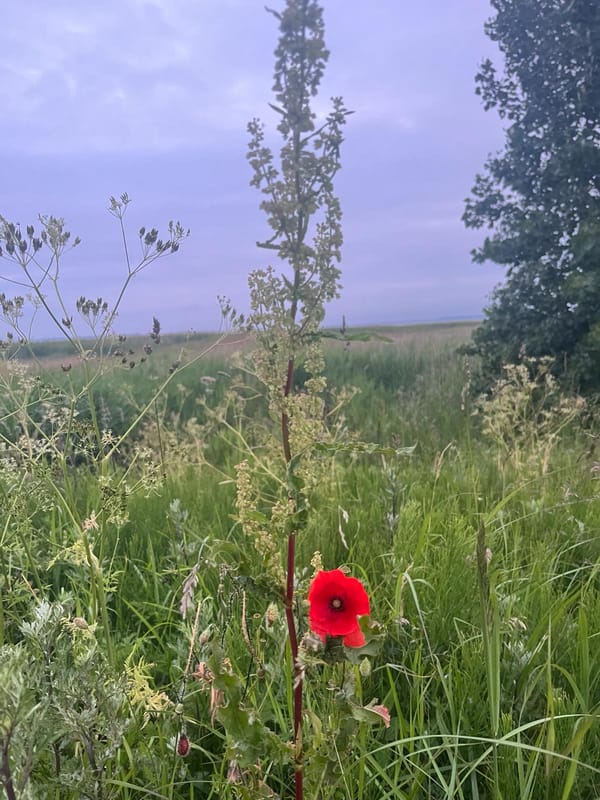
The Accumulated Field — Place as Living Archive
A Reference Document — The Framework Behind Gut Nisdorf as Sacred Ground
Written at Gut Nisdorf, Mecklenburg-Vorpommern. Day 3. Navratri closed.
In response to what the ground revealed when asked directly.
A Necessary Correction
This plan carried a statement that requires honest revision.
The original formulation: Gut Nisdorf is made sacred by the quality of human attention — not a pre-existing holy place.
That statement is true as far as it goes. It was written to resist the projection of imported spiritual significance onto a place the pilgrim had not yet arrived at. The caution was correct.
But it is incomplete. The archaeology of this coast makes it incomplete.
The quality of human attention to this specific ground runs back five thousand years. The pilgrim who arrived on March 26, 2026 was not the first to treat this coast as a threshold. He was arriving into an accumulated field — one that successive cultures had laid down, layer by layer, through their own quality of attention, long before his boots touched the soil.
The correction is not that the place was always already holy in some abstract sense. It is that the statement "not a pre-existing holy place" misunderstands how sacred landscapes actually form. They do not arrive holy independent of human presence. They become what they are through accumulated human presence — through the return of each generation to the same ground, recognizing in it something that calls to the quality of attention they carry.
The field at Gut Nisdorf is pre-existing. It was deposited here. That is different from the ground being magical without human relationship. It is the ground having held a long conversation with human attention — and that conversation being still audible, to the body that is present enough to listen.
The Layers
The Funnelbeaker People (Trichterbecherkultur), 3500–3200 BCE
Up to five thousand megalith tombs — Hünengräber, giants' tombs — were erected across Mecklenburg-Vorpommern by the people of the Neolithic Funnelbeaker culture. They were built from glacial erratics across a span of approximately two hundred years — seven generations — during which the entire available stone was shaped and placed with extraordinary deliberateness.
These structures were thresholds between the living and the dead. They were not closed after first use. The chambers were returned to, generation after generation, through the Bronze Age, the Iron Age, and into the Slavic period — secondary burials deposited inside Neolithic chambers across three thousand years of continuous use. Each culture found the mound already standing and chose to return.
This is the most important fact about these structures: not their original construction but their reuse. Culture after culture, arriving in this landscape with no knowledge of the theology of the people who built the mound, recognized something in the place that called to their own threshold practices. The accumulated quality of that recognition is what makes a landscape sacred — not a declaration from any single tradition but the convergent return of many.
There are almost certainly such tombs within walking distance of Gut Nisdorf. The ground underfoot has been carrying the dead, continuously, for five thousand years.
The Nordic Bronze Age, 1700–500 BCE
A sun-centred culture with strong Scandinavian connections worked this coast for twelve centuries. The Baltic Bodden waters — the lagoon system that forms the boundary between Gut Nisdorf's landscape and the open sea — were understood as sacred boundary water. Bronze votive deposits were made in water. The threshold between land and water, between the visible and the submerged, was the place where the ordinary and the sacred met.
In approximately 1300 BCE, perhaps four thousand warriors from across Central Europe fought a major battle in the Tollense Valley — directly inland from this coast. The largest known Bronze Age battle in Central Europe. The warriors had traveled from far outside the region to fight here, which means this landscape was already the kind of place significant enough to draw that convergence.
The sun orientation of Bronze Age practice is directly relevant to the plan. Sun salutations facing east toward the Bodden each morning are one more layer in a field that has been oriented toward light and water since 1700 BCE. The body doing the salutations does not need to know this consciously. The place knows it.
The Rani (Rujani), 9th–12th Century CE
The most immediate pre-Christian layer — and the one most directly present in the landscape around Gut Nisdorf.
The Rani were a West Slavic tribe based on the island of Rügen and the southwestern mainland across the Strelasund. Gut Nisdorf is on that mainland. The Strelasund is narrow; Rügen is visible from this coast on a clear day. This was Rani territory.
Their religious and political centre was Cape Arkona, at the northernmost point of Rügen — the last stronghold of Slavic paganism in this region, whose significance for the Baltic Slavs was described by contemporaries as comparable to Delphi for the ancient Greeks. The temple there was dedicated to Svantevit — a four-faced god associated with war, fertility, harvest, and prophecy simultaneously. Four faces: all four cardinal directions held in a single presence.
Once each year, after the harvest, a large festival was held. The priests carried out divinations using a sacred horse and a drinking horn filled with wine — the fullness or depletion of the wine measuring what the year ahead would bring. This was not simply a harvest ritual. It was a structured annual passage: the community gathering at the threshold between the year's work and the unknown year ahead, using the quality of collective attention to read what the ground had received and what the coming season would require.
The Rani worshipped their gods in temples, in holy groves, and in ritual meals at home. Not three separate categories — one continuum. The sacred was not sequestered in a dedicated space. It was present in the daily act of eating from the ground you had worked, in the grove at the edge of the field, and in the temple at the cape. The boundary between the ordinary and the sacred was deliberately thin — maintained thin by daily practice, not only by annual festival.
In 1168, Danish forces under King Valdemar defeated the Rani, burned the temple at Arkona, and forced conversion to Christianity. The wooden statues of the gods were destroyed. The groves were replaced by churches. Ritter Johannes von Nisdorf is first documented in 1302 — one hundred and thirty-four years after that destruction. The Christian knight-farmer who gave the place its name arrived into a landscape still carrying the living memory of what had been there.
The ground under Gut Nisdorf holds that memory. Not as mythology. As the accumulated quality of attention deposited by a people who understood the daily meal, the field, and the threshold between the known and unknown year as a single sacred continuum.
What Accumulated Human Attention Does to a Place
The mechanism is not mystical. It is structural — and it aligns directly with the scientific ground this plan already stands on.
Zach Bush MD's framework establishes that the microbiome of the soil and the microbiome of the gut are in direct biological conversation. The quality of that conversation depends on the history of the soil — what has been added, what has been removed, what relationships have been cultivated and what have been severed.
The same principle applies at the level of place and practice. A landscape that has been the site of sustained, intentional human attention carries a different quality of invitation to the body that arrives in it than a landscape that has not. This is not a metaphysical claim. It is the recognition that human practice leaves traces — in soil chemistry, in landscape shaping, in the patterns of what grows where, in the memory encoded in the physical structure of the place.
Achim Ecker's Terra Preta practice — the deliberate rebuilding of microbial complexity through biochar addition — is structurally identical to what the Rani understood as feeding the ground. The form differs. The recognition that the ground must be in relationship with human attention, must be given as well as taken from, is the same principle arrived at from two directions separated by eight hundred years.
The megaliths were not built for the dead alone. They were built as structural reminders to the living: this is where the threshold is. Return here. The place marks the practice, and the practice marks the place, and over five thousand years that mutual marking becomes something the arriving body can feel before it understands why.
Pattern Language of Place
The Erdpuls methodology — Pattern Language of Place — holds that specific landscapes carry patterns that precede and exceed any individual practitioner. The practitioner does not create the pattern. They enter into a conversation with a pattern already present, and the quality of their attention either deepens or disrupts it.
The pattern at Gut Nisdorf, now legible across five thousand years of documented human attention, is this:
Threshold. Return. The daily and the sacred undivided. The ground fed and feeding.
Not one culture's theology. Not imported meaning. The convergent recognition of successive peoples — Funnelbeaker, Nordic Bronze Age, Rani, and now Achim's permaculture practice and the pilgrim's twelve weeks — that this specific coast, this Bodden boundary, this place where land and water and sky meet at a particular angle of light, is where ordinary time becomes permeable to something larger.
The pilgrim did not arrive at a neutral site to which he would bring sacred meaning from elsewhere. He arrived into a field already structured by five thousand years of exactly the quality of attention his plan requires: sustained, embodied, threshold-oriented, daily, and directed toward the same question in every generation — what does the ground ask of the body that lives here?
Implication for the Practice
The statement that this plan now carries is more accurate:
Gut Nisdorf is made sacred by the accumulated quality of human attention — layer upon layer, culture upon culture, from the Funnelbeaker tomb-builders through the Nordic Bronze Age to the Rani harvest festivals to Achim's daily work in the soil. The pilgrim's twelve weeks are one more layer in a conversation that has been going on for five thousand years.
The sun salutations face east. The Bodden water is visible at the edge of the property. The soil receives the hands. These are not gestures invented for this plan. They are the continuation of a practice this ground already knows.
Der Boden trägt. The ground holds — because it has been holding for a very long time.
License and Attribution
© 2025–2026 Michel Garand | A Pilgrim's Fitness Plan
Gut Nisdorf, Mecklenburg-Vorpommern, Baltic Coast, Germany
Licensed under Creative Commons Attribution-ShareAlike 4.0 International (CC BY-SA 4.0)
You are free to share and adapt this material for any purpose, including commercially, provided you give appropriate credit, provide a link to the license, indicate if changes were made, and distribute any adaptations under the same license.
This document was developed with assistance from Claude (Anthropic PBC). All strategic decisions, philosophical positions, and personal commitments are those of the author.
Contact: stewarship@ubec.network
A Pilgrim's Fitness Plan — Gut Nisdorf 2026
Gut Nisdorf, Mecklenburg-Vorpommern — March 2026