Marshall B. Rosenberg — Love Is Not a Feeling
Nonviolent Communication — The Giraffe and the Wolf
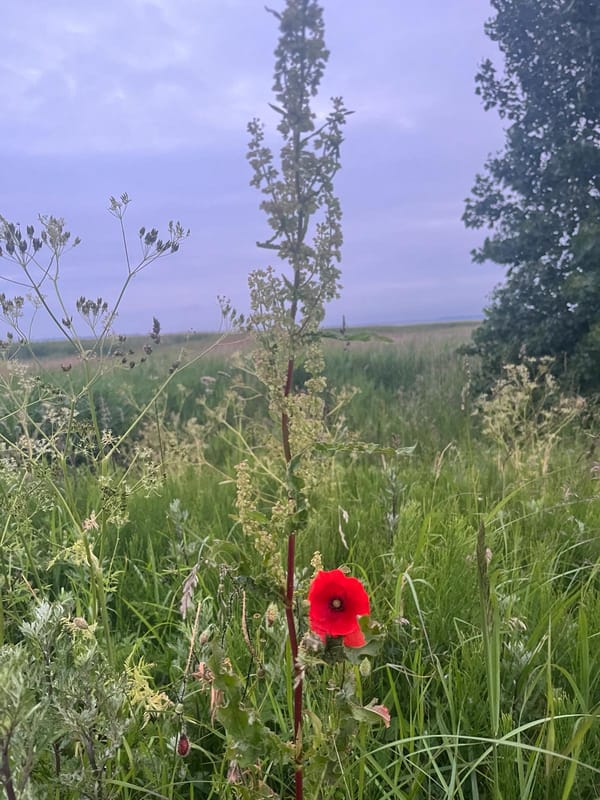
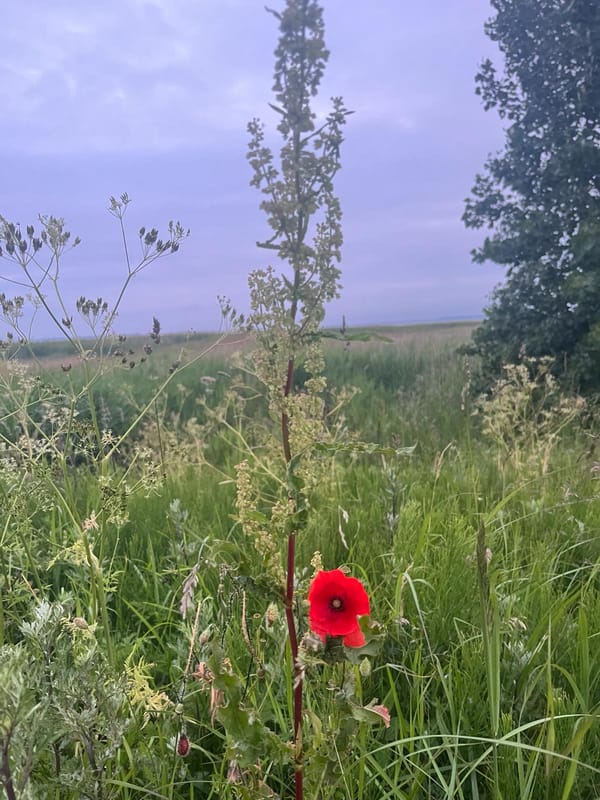
Found in Michel's files in 2019. Surfaced on the train through the Oderbruch, April 18, 2026.
Source: Interview with Marshall B. Rosenberg by David Luczyn and Serena Rust, MultiMind 5/04.
The Provocation
Love is not a feeling.
When we say "I love you," it can be thirty different feelings. Joy, passion, gratitude, connection, relief — each one distinct, each one asking for a different response. The word "love" alone says almost nothing about what is actually alive in the person who speaks it.
Rosenberg's discipline: pause before the word and ask what is actually present. Name it precisely. The specificity is the love.
The Four Steps
Nonviolent Communication moves in four steps — applied equally to expressing oneself and to listening to another:
Observation: What I see, hear, or experience. No evaluation, no interpretation. The fact as it is.
Feeling: What I feel in response. Distinguished carefully from thoughts — "I feel that you..." is not a feeling. "I feel afraid" is.
Need: The need underlying the feeling. Universal — independent of time, place, and person. Not a strategy, not a demand. A need is a part of life present in every human being.
Request: What I am asking for. Distinguished from demand — a request leaves the other person genuinely free to say no. A demand does not.
The four steps in either direction: expressing what is alive in me, or hearing what is alive in you. Both require the same precision.
Wolf and Giraffe
Rosenberg uses two animals as symbols.
The wolf communicates in a life-alienated register: needs expressed as criticism, judgment, demands, Feindbilder. The wolf does not say what it needs — it says what is wrong with the other person. The weapons dealers get rich. So do the divorce lawyers.
The giraffe — the animal with the largest heart of any land mammal — speaks from the neck up, sees further, names what is alive without weaponising it. The giraffe makes requests without coercion. It sees the human being, not the role.
"You never listen to me" is wolf language. "When I finish speaking and you immediately pick up your phone, I feel invisible — I need to know I have your attention. Would you be willing to put it down while we talk?" is giraffe language.
The difference is not tone. It is structure. Wolf language hides the need inside the criticism. Giraffe language states the need directly and makes a clear request.
Needs and Strategies
A need is universal. A strategy is particular.
The same need — for safety, for connection, for autonomy, for meaning — can be met by a thousand different strategies. Confusing a strategy with a need is how couples spend thirty-nine years arguing about a checkbook when the actual needs are economic security and trust respectively — solvable in twenty minutes once named.
"He never wants me to spend money" is a strategy described as a need. "He needs the family to be economically protected" is the need. Once the need is heard, the conflict dissolves — not because the problem disappears, but because the two people can now actually see each other.
The FOR/WITH distinction maps directly here. Building FOR someone is a strategy imposed without checking the need. Building WITH someone requires first asking — and actually hearing — what the other person needs.
Love and Meaning
Rosenberg distinguishes the need for love from the need for meaning. Both are fundamental. They are often confused — especially in cultures that teach that the entire meaning of life depends on being desired by a specific person.
Viktor Frankl is cited: the need for meaning may be the deepest need of all. Many people who live well without a partner have found meaning through work, through service, through something larger than any single relationship. The need for love remains — but it does not exhaust the need for meaning, and the need for meaning does not substitute for love.
The pilgrimage holds both. The twelve weeks at Gut Nisdorf are a search for meaning — what does the body carry, what does the ground hold, what can one pilgrim do. The dedication to Susi holds the love thread. Both true simultaneously.
Rising in Love
We have always said falling in love. The language carries the full weight of what it implies — loss of control, loss of ground, descent. Something that happens to you from outside. You do not choose it. You fall.
But is it possible to rise in love?
Rising requires ground to stand on. You cannot rise from nothing. You rise from a place of stability — toward something, by choice, with both feet planted. Rising is not passive. It is a movement made from the centre outward.
Rosenberg's four steps are a rising practice. To name precisely what is alive — observation, feeling, need, request — is to rise toward the other person rather than fall into them. To make a request rather than a demand is to rise. To see the human being rather than the role is to rise.
The FOR/WITH correction is a rising. You cannot rise WITH someone if you have no ground of your own. The pilgrimage at Gut Nisdorf is the practice of finding ground stable enough to rise from.
Falling in love was 2019. Rising in love is what 2026 is learning.
The morning gratitude practice — three specific things named each day before the Morning Anchor closes — is Rosenberg's four-step model in compressed form. Not "I am grateful." What specifically happened. What feeling it produced. What need it met. Named plainly, without sentiment.
The blog voice itself is giraffe language applied to prose. Observation without evaluation. Feeling reported without editorialising. No demands made on the reader. The reader's response is their own.
The FOR/WITH pattern identified during this pilgrimage as a lifelong habit — Rosenberg named this in 2004. It arrived in Michel's hands in 2019. The correction is being lived in 2026.
A Pilgrim's Fitness Plan — Gut Nisdorf 2026
© 2025–2026 Michel Garand | CC BY-SA 4.0 | stewardship@ubec.network