Reflections and Recalibration of a Pilgrim — During a Six-Hour Train Ride
Day 10 — Easter Sunday — Müllrose to Gut Nisdorf
Easter Sunday. The 7:11 from Müllrose. Bicycle secured in the train. Six hours north toward the Baltic coast. The landscape moving past the window at train speed.
The body knows before the mind does.
Wake-up feel this morning: 8 and tired. Both true simultaneously. The 8 is not performance — something settled overnight, something released. The tired is the body accounting for three days of held position: the tent, the house, the tower, the table, the night that became complete. Now the body is in motion again and it is doing what bodies do after transitions — not relaxing, recalibrating. There is a particular quality to this state. Alert and slow at once. The nervous system taking stock.
At 7:11 the train pulled out of Müllrose. The platform disappeared. Brandenburg opened up on both sides of the window — flat, wide, the early morning light still low and thin. The body exhaled without being asked.
Bicycle secured in the train. This matters more than it might seem. The thing that will carry me through the land at Nisdorf — slowly enough to feel the ground, fast enough to cover it — is here, waiting. The pilgrim's instrument. It came with me this time. On March 26 I rode to the station in Müllrose on this bicycle — and left it there. It waited. Today it comes north with me. Something has shifted in how I understand what the next eleven weeks ask of me.
Practice is not what you do when conditions are perfect. It is what you bring to the days the calendar gives you — the tent, the tower, the train, the bicycle. The practice does not wait for readiness. It meets you where you are.
The landscape outside is Brandenburg — flat, lake-threaded, forest-covered. It looks simple. It is not.
This entire region was shaped by ice. The Weichsel glaciation retreated approximately twelve thousand years ago, leaving behind the Oder, the Havel, the Spree, the chains of lakes the train passes through or near. It left sandy, acid soils — thin and poor — which is why Brandenburg grows rye and pine rather than wheat and oak. The land remembers the ice in its bones. You can read it in the texture of the soil, in the particular quality of light through pine forest, in the way the water sits in the landscape — flat, still, holding.
As the train moves north toward Mecklenburg-Vorpommern the soil deepens slightly, the landscape opens. The Baltic coast is where the ice met the sea — a different kind of edge altogether. The land at Nisdorf sits on that edge. Five thousand years of human attention on a coast that was itself shaped by ten thousand years of post-glacial rebound — the land still slowly rising as the ice-weight lifts. The Accumulated Field does not begin with Ritter Johannes von Nisdorf (Johannes de Ost de Neslestorp), 1302. It begins with the first Mesolithic hunter-gatherers who moved north as the tundra gave way to forest, following the animals, following the fish, arriving at a coast that was still forming.
That is the oldest layer. The ice made the land. The land drew the people. The people made the ceremonies. The ceremonies named what the land was already doing.
Every culture that has survived a northern winter has built a ceremony for the spring hinge. Not as decoration — as necessity. Something must be done at the turning point or the turning point is missed.
The peoples who lived in this landscape before Christianity — Slavic, Germanic, Baltic — held the spring equinox as a fire ceremony. Osterfeuer. Easter fire. You light the fire not as symbol but as act. You call the sun back. You jump the fire to carry its strength into your body for the season ahead. This is not metaphor. This is technology — the technology of attention, of participation, of the human being consciously entering the system rather than observing it from outside.
The name Easter almost certainly derives from Ostara — the Germanic goddess of spring, of dawn, of the returning light. The church placed its death-and-resurrection story at this hinge because the story was already here, already in the land, already in the people. The hare and the egg are hers, not the church's. The church absorbed what it could not remove.
Move the lens outward. In Mesopotamia — the oldest written civilisations — Tammuz, the young god of vegetation, was mourned in winter and celebrated in spring. The death and return of the growing force, written into the oldest human records we have. In Egypt, Osiris was killed, dismembered, reassembled, restored — the Nile falling and rising again, the grain dying into the ground and pushing back through. In the Andean world, Inti Raymi called the sun back at the solstice: the same reckoning, a different hemisphere, an identical logic. The Haudenosaunee — the Six Nations of the northeastern woodlands of North America — give a Thanksgiving Address before every significant gathering, naming each part of the living world — the grasses, the trees, the water, the winds, the sun — and acknowledging each for continuing to do its work. Spring is when that continuation becomes visible again after winter's silence.
What ancient wisdom across every culture points toward is the same understanding: the human being is not separate from the living system. The ceremonies are not about the gods. They are about the people remembering what they are part of. That remembering is the oldest form of practice we have.
The common thread is not theology. It is epistemology. These traditions understand the human being as participant, not observer. The system includes you. The sun does not return on its own — it returns with the participation of the conscious beings who live within its reach. Sun Tzu understood this about terrain: you do not observe the battlefield from outside it, you are inside it, and the terrain is reading you as much as you are reading it. Fuller would recognise this immediately. There is no view from nowhere. The observer is always part of what is observed.
In Traditional Chinese Medicine the year moves through five seasons, not four. Spring is Wood. The organ is the Liver, paired with the Gallbladder.
The Liver in TCM is the organ of vision — not eyesight, but the capacity to see forward, to plan, to move toward what is not yet present. It governs the Hun — the ethereal soul, the part of the person that dreams, that imagines futures, that holds the thread of purpose across time. When the Liver is healthy the person moves with direction and flexibility. When it is congested — from winter stagnation, from unexpressed anger, from plans held too long without movement — the whole system tightens.
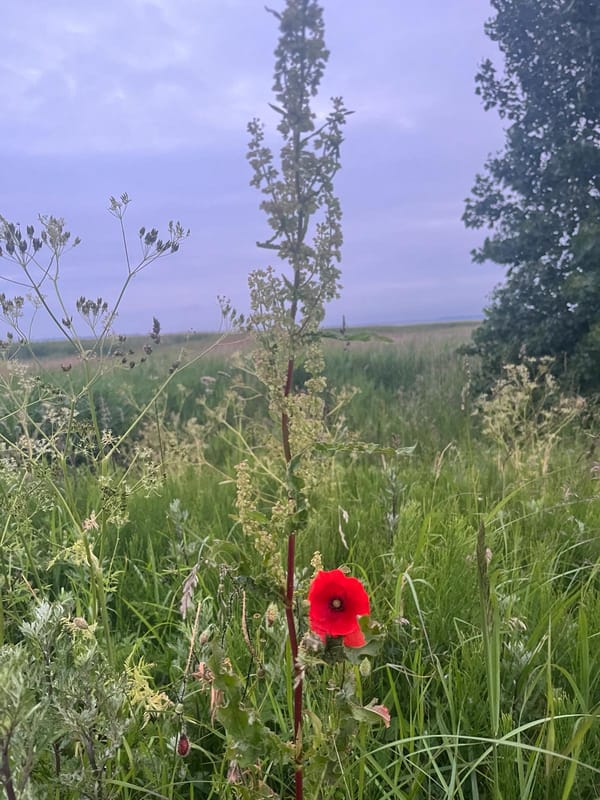
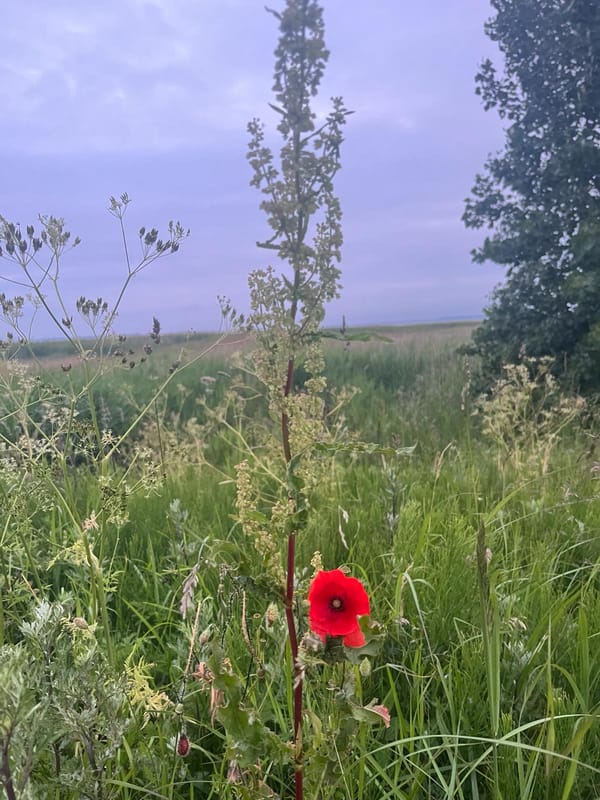
Look out the window. The trees are not yet fully leafed — but the buds are breaking. That green haze at the tips of every branch is Wood energy made visible. The sap is pushing through the cambium layer of every tree in this landscape. That is the same force the Liver is working with in the human body right now. The season and the organ are one system.
Phase 1 of the Pilgrim's Fitness Plan is Touch — Lung — the Metal element — autumn's organ. I am living it in spring, which means the Wood energy of the season runs underneath the Metal practice. The Liver is pushing forward. The Lung is learning to let go. Metal and Wood, autumn and spring, release and vision — not in opposition. In conversation. The tension the pilgrim is actually living, not resolving.
Rudolf Steiner understood the earth as a breathing organism. In spring and summer the etheric forces stream outward, upward, into the cosmos — the earth exhales. In autumn and winter they draw back in, concentrate, go underground — the earth inhales. Easter falls exactly at the moment the out-breath begins. The earth is opening.
Steiner also understood Touch — the boundary sense, the sense that establishes where I end and the world begins — as the sense most active at this threshold. In spring the boundary becomes more permeable. The skin responds to warmth and light differently than in winter. The pilgrim practicing Touch at this season is practicing at the exact moment when the earth itself is most available to be touched. The biodynamic calendar maps this directly: the cosmic forces working through the silica process, the light process, the forces that build form upward toward the sun. You do not practice in isolation from the season. You practice inside it.
Charles Fillmore understood Easter as an inner law of regeneration — not the story of one man but the pattern available to every human being willing to do the work of awakening the Christ consciousness within. For Fillmore the body was not the obstacle. The body was the site of the resurrection. He mapped twelve inner faculties of the human being — faith, strength, wisdom, love, power, imagination, understanding, will, order, zeal, elimination, life — as the instruments through which regeneration actually happens. At Easter the faculty of Life stirs and rises. The physical body is not separate from this movement. It is where the movement occurs. Regenerating the body you already have — Fillmore would have recognised that impulse immediately.
Why does a person become a pilgrim?
Not to escape. To enter more fully. The pilgrimage is the structural condition that makes honest living possible — the deliberate removal of the comfortable distance between the self and the life it is actually living. The pilgrim gives up the view from the window and steps outside. The terrain becomes real because the body is in it. The season becomes real because there is no roof between the skin and the sky. The practice becomes real because there is nowhere else to be.
Every tradition that has sent people on pilgrimage — the Camino, the Hajj, the Aboriginal walkabout, the vision quest, the wandering of the Taoist sage — understood this. The journey is not the point. The stripping away of what is not essential is the point. What remains when everything unnecessary falls away — that is what the pilgrim is walking toward.
I arrived in Müllrose on Good Friday. I leave on Easter Sunday. I did not plan this — the calendar built the frame.
Good Friday names the locking. The day the path stops, the stone is rolled, the ground holds what has been placed in it. I walked a kilometre in the dark to a tent in a garden and named what I had been carrying. Homeless. Thirty-one years in Germany. The container in Frankfurt (Oder). Death ground — not as drama, but as fact.
Easter Sunday names the opening. The stone moves. The pilgrim walks out. Not rescued from outside — moved from within.
Between these two days: Julika's birthday. She turned eleven. The tower above Słubice, the whole region spread below. The family table. The evening that settled into something quiet and warm. Her mother Susi — the woman who initiated the separation that brought me to this pilgrimage, not from weakness but from a woman finding her own ground — made an offer: don't sleep in the tent. Stay. I accepted. We had supper. We watched television. The night became complete on its own terms.
What moved through that evening had no condition attached to it. No expectation of continuity, no claim on the future. That is what unconditional love actually looks like in practice — not the grand gesture, but the warmth that asks nothing of tomorrow. The pilgrim receives it. Sets it down. Moves on.
Julika was born on Easter Sunday 2015. Yesterday she turned eleven — one day before Easter fell this year. The same axis, one day displaced. Her birth lives on that calendar hinge between death and resurrection whether Easter moves or not.
Three days, three movements. The ancient peoples who held fire ceremonies at this hinge would have recognised the shape immediately. Not the theology — the shape. Death ground, threshold, return. The same shape the year takes every time.
There is a lock on a bridge in Müllrose. It has been there for years. It was sealed by two people who knew what they were doing. It is still hanging — not asking to be removed, not capable of being ignored.
Good Friday names the locking. Easter names the opening. The lock on the bridge in Müllrose is both — sealed years ago, still hanging, neither asking to be removed nor capable of being ignored.
The train is moving north. The landscape outside is in the hinge — trees almost leafed, light almost warm, the earth's out-breath just beginning. The bicycle is in the train. Eleven weeks of work are ahead.
Coelho's Warrior of Light knows that the path is not a vow of absence from life. The warrior receives what arrives — without clinging, without fleeing — and sets it down when it is complete. The night in Müllrose was complete. The departure this morning is clean.
The pilgrim did not plan this. The pilgrim simply showed up on the days the calendar gave him.
Michel Garand
On the train — Müllrose to Gut Nisdorf — Easter Sunday, April 5, 2026
Phase 2 — A Pilgrim's Fitness Plan
© 2025–2026 Michel Garand | A Pilgrim's Fitness Plan
Gut Nisdorf, Mecklenburg-Vorpommern, Baltic Coast, Germany
Licensed under Creative Commons Attribution-ShareAlike 4.0 International (CC BY-SA 4.0)
Contact: stewardship@ubec.network