Pillar VI — Der Boden
The Seven Pillars of Nisdorf — A Pilgrim's Journal, 2026
March 24, 2026. Skandamata. Day 5 of Navratri. Berlin time.
I am present. Anchor. Commitment. Foundation. Cornerstone.
The grey zone has its season.
Presence isn't about screen time.
At Gut Nisdorf, I surrender completely.
Der Boden. The ground we stand on.
I asked whether I was over-sensitive — manufacturing depth in ordinary events, searching for meaning in everything as a habit of this phase of life. The question is honest. It deserves a direct answer.
Yesterday evening, coming home with Julika after boxing training, we found out that my ex-mother-in-law had been taken to the emergency room. Her partner had not called anyone. No one knew what was happening. Susi asked me to go to the hospital. I went. Nothing life-threatening — a fracture in the leg. She was home the same night. An operation in the coming days.
Susi sent a message thanking me. I answered: No problem, that's what families are for.
I did not manufacture that sentence. I did not pause to decide whether it was appropriate given the circumstances of the last years. It came from somewhere that was not calculating. It came from the ground.
That is the answer to the question about over-sensitivity. Over-sensitivity searches. The ground does not search. It holds.
The source of the long conflict was this: protecting myself from being hurt, and at the same time claiming unconditional love. The two operated simultaneously and in opposite directions. Self-protection requires distance, managed exposure, a boundary held. Unconditional love requires full presence, no conditions, no self-protection as a precondition.
The system locked. Not because I was wrong to protect myself. Not because the love was false. But because both were operating on the same level — and the same moment cannot hold two contradictory postures at once without cost.
What the five pillars before this one have done — in sequence, without planning the sequence — is locate the level beneath both. Not the level where protection and love compete. The level that makes both possible without either cancelling the other.
Today is Day 5 of Navratri. The form is Skandamata — the mother who carries the child on her lap while riding the lion. Protective love. Voice. She does not appear here as decoration. She appears because she is the image of what the ground makes possible.
Skandamata rides the lion. She carries the child on her lap. She does not choose between tenderness and danger. She does not protect herself from the lion in order to be safe enough to hold the child. She holds the child and rides the lion because she knows what she is standing on. The lion does not throw her. The child does not fall.
That is not a skill. It is a ground condition.
Der Boden — the German carries what English does not fully reach. Ground, yes. But also soil — the thing things grow from. Floor — the thing the body knows under its feet. Foundation — the structural base. Bottom — what remains when everything above it has shifted.
Erdpuls is built on this word. The fitness plan is built on this word. Der Boden is not metaphor in German. It is substance.
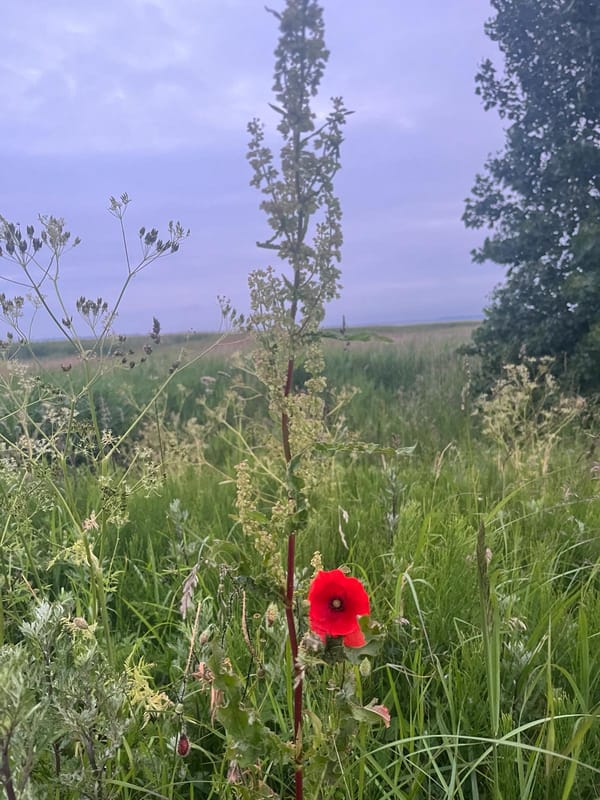
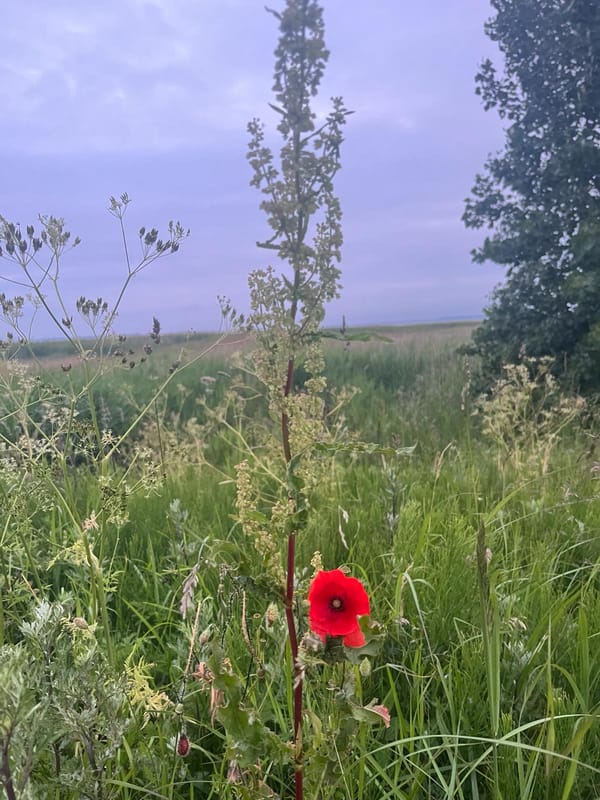
The garden at Gut Nisdorf is literally Boden. Achim works it. The pilgrim arrives and works it. The body learns what the hands already know — that the ground gives back what is put into it honestly, and does not respond to performance.
Pillar III named the seed — wir werden sehen. Pillar VI names what the seed is planted in.
This pillar was not constructed this morning. It was lived last night — at the hospital, in the corridor, asking a nurse about what happened to my mother-in-law, knowing Susi was waiting for a message, knowing Julika was alone at home.
The ground does not announce itself. It is simply there — or it is not. Last night it was there. The sentence that's what families are for was not strategic. It was not performed for effect. It came from the level below the conflict, the level below the protection and the love competing with each other.
Pillar VI arrived before it was named. That is how the ground works. You don't find it — you discover you were already standing on it.
This morning, making coffee, I almost forgot the exercise. Something stopped me. I put the coffee down and went. Not a heroic act — a small recovery. The rhythm is not yet in the body. It is still being chosen consciously, against the pull of the ordinary morning. The choosing is the practice. At Gut Nisdorf there will be cold mornings and warm coffee and the same choice. The choosing is what builds the rhythm. The rhythm does not arrive and then make the choosing easy. The choosing, repeated, becomes the rhythm.
During the exercise, something surfaced that the sitting mind had not produced. A thought — or less than a thought, more than a feeling. Something close to: I release Susi.
I am not certain of the exact form. The uncertainty is honest. What I know is the sequence of what the body felt: recognition first. Then relief.
Recognition means the body already knew. The thought did not arrive as new information — it arrived as confirmation. The same movement as Pillar V. Not naming something unknown. Confirming something that was already load-bearing before it was spoken.
The relief came after. Because recognition without release is clear-eyed holding. The relief is the holding becoming unnecessary. Not dropping. Opening.
Release is not loss. It is not abandonment. The lock on the bridge still has both names on it. Release does not remove the names. It changes what the hands are doing — from gripping to open.
In scripture — Moses at the burning bush. The instruction is not look at the fire. It is remove your sandals, for the place where you are standing is holy ground. Before the commission, before the name, before the law — the first act is to remove the insulation between the sole of the foot and the earth.
The ground was holy before Moses arrived. The encounter did not make it holy. The encounter revealed what the ground already was.
In Sun Tzu — the nine grounds. The last is death ground — the terrain from which there is no retreat. The general places his army where return is impossible, then burns the boats. Not recklessness. The removal of the option that was draining every soldier's presence — the option of leaving. While leaving remains possible, part of every soldier's mind is already calculating it. Remove the option and the whole person arrives. The ground holds them not by force but by the elimination of the alternative.
Moses removes the sandals voluntarily. The army on death ground has the boats removed. Two paths to the same barefoot condition. Direct contact with what was always there.
The conflict named this morning — protection and unconditional love operating simultaneously — is the sandals. The insulation. Not wrong, not evil. Necessary in its season. But the ground was holy before they were put on. And the ground is still there when they come off.
Julika was born on Easter.
Not near Easter. On Easter. The feast is not a coincidence of the calendar this year — it is her day.
I leave in two days. I return to her in a little over a week — on her birthday, on the feast that is structurally about what the ground does when it has held a seed long enough. The arc is tight. Not twelve weeks and then Easter. One week, and then Easter, and then the rest of the twelve weeks begins in earnest. The return to Julika at Easter is not the end of the pilgrimage. It is the first confirmation. The ground showing, early, that it holds.
She asked where I will sleep at her birthday. Not where she will sleep — where I will sleep. Ten years old, and she is already holding the logistics of her father's homecoming. Making sure there is a place for him on her day.
She draws teleporters. The technology of instant return. Not because she is afraid of the departure — because she is already solving for the coming back.
The ground holds what is entrusted to it. Julika already knows this. She learned it in the body, the way children learn what they live. She is doing it now — practically, concretely, without drama.
Where will you sleep, Papa?
Pillar III: the seed, wir werden sehen. Pillar VI: the ground the seed is planted in. Easter: what the ground does when the holding has done its work.
The departure and the return are not separate events with a gap between them. They are one arc. The burial and the emergence are not separate events. They are what the ground does with what is entrusted to it.
Der Boden trägt.
License and Attribution
© 2025–2026 Michel Garand | A Pilgrim's Fitness Plan
Gut Nisdorf, Mecklenburg-Vorpommern, Baltic Coast, Germany
Licensed under Creative Commons Attribution-ShareAlike 4.0 International (CC BY-SA 4.0)
You are free to share and adapt this material for any purpose, including commercially, provided you give appropriate credit, provide a link to the license, indicate if changes were made, and distribute any adaptations under the same license.
This document was developed with assistance from Claude (Anthropic PBC). All strategic decisions, philosophical positions, and personal commitments are those of the author.
Contact: michel@ubec.network
A Pilgrim's Fitness Plan — Gut Nisdorf 2026
Gut Nisdorf, Mecklenburg-Vorpommern — March 2026