On the train
Between Two Worlds
March 26, 2026 — on the train to Gut Nisdorf
The first post ended with the train at 07:11. This one begins inside it.
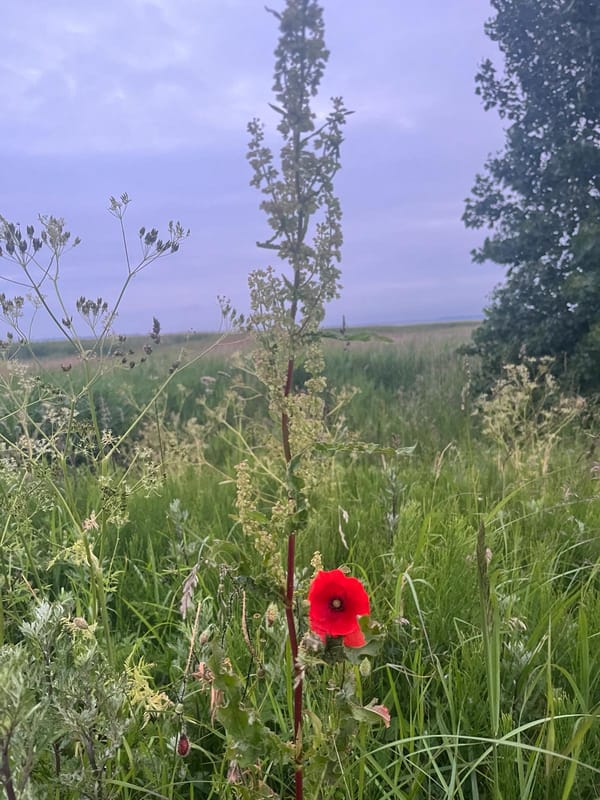
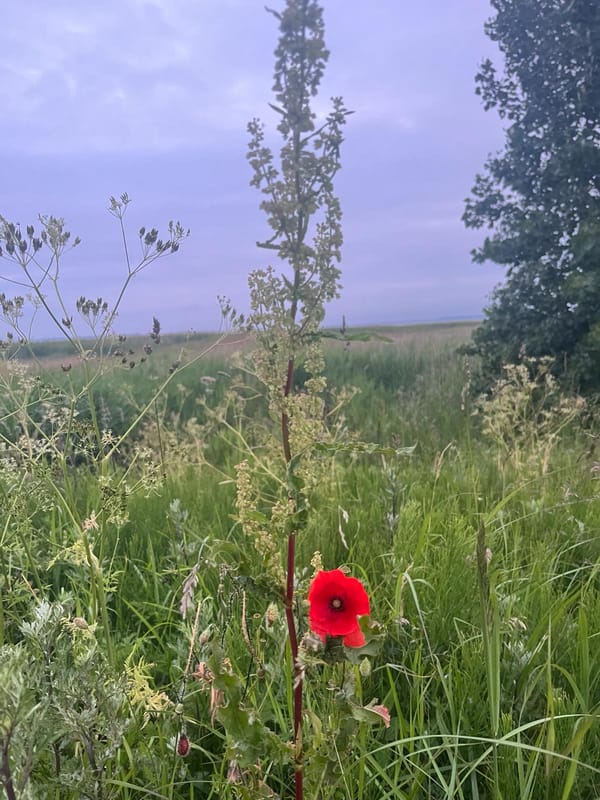
It is 12:07. Arrival at Gut Nisdorf is 14:03. I am somewhere in Mecklenburg, moving north, and the landscape out the window is beautiful in the way that flat land near water is beautiful — wide, unhurried, lit differently than Brandenburg.
The bicycle
I did not ride a donkey to the train station this morning.
I rode my bicycle.
Kalaratri — the seventh form of Durga, the dark night, the most fearsome of the nine — rides a donkey. Plain, honest, unglamorous. The vehicle of the long road. But this morning, at not yet seven in the morning, I rode through Brandenburg on two wheels under my own power, bag on my back, to Frankfurt (Oder) station. I arrived at the threshold under my own steam.
It felt right.
The bridge
My daughter Julika is ten years old. Last night, when we were talking through the details of the morning, she decided she would walk with me — not to the station, but to the bridge. Far enough to mark the departure. Close enough not to be late for school.
At the bridge we parted. She turned left toward school. I turned right toward the train.
The bridge keeps appearing in this story. There is a lock on one of the Brandenburg bridges with two names on it. I left coordinates in a letter. The pylons are still in the water. The structure changes form but holds.
This morning it was the simplest version: a ten-year-old and her father, parting at the crossing. She said what she says when things are what they are: es ist wie es ist.
Harmonious. That is the word for it.
The mother and child
I changed trains in Berlin. I wanted the peace of a threshold crossed alone — quiet, no demands, just the motion north. I found a seat, settled.
Then a mother appeared in the doorway with a pram. She needed help getting the Kinderwagen through. I stood up and helped her. She sat down beside me.
I had not sought this. And then became the reason it happened.
This is not the first time. At the crossings throughout my life — the significant ones, where the ground shifts — a mother with a young child has appeared. I no longer call it coincidence. I am apparently not a man who can successfully avoid this particular encounter, because I am also apparently not a man who can watch someone struggle with a pram and stay in his seat.
In the Navratri sequence, the fifth form of Durga is Skandamata — the mother who carries her child on her lap while riding a lion. She does not choose between the vulnerable and the dangerous. She holds both, on the same ground.
A threshold conversation. Complete in itself. Nothing to hold, nothing to follow.
Between two worlds
The seven pillars are standing. I counted them this morning, somewhere between Müllrose and here, as the landscape widened and the sky opened.
Seven mornings. Seven pillars hewn in the darkness before Brandenburg woke. The house is built. And now the eighth day — Navratri Day 7, Kalaratri, the dark night — is not a day of arrival or departure but of crossing. The train holds me in the between.
Not Brandenburg anymore. Not Gut Nisdorf yet. No address, no obligation. Just motion and flat light and the memory of a bridge and a girl turning left.
Someone once said: stop that train. The train does not stop. That is what makes it the right image for a threshold — it moves on its own schedule. You board or you don't.
I boarded.
Gut Nisdorf arrives at 14:03. Achim is at the other end. The garden is waiting. The Baltic light will be different from the Brandenburg light.
The feast begins today — even on the train, even in the between.
Ehyeh asher Ehyeh.
A Pilgrim's Fitness Plan — Gut Nisdorf 2026
Michel Garand | CC BY-SA 4.0
pilgrims.ubec.network