What Sense of Place Does to the Body
Day 39b at Gut Nisdorf — Environmental Need
Two smells on the winding road this morning. No mixing.
March 26. Arrived on foot. The first thing the body registered — before the mind had a name for it — was the quality of the air. Not the temperature. The texture. Something opened in the chest that had not opened in Brandenburg.
Tristan Sosteric's second need is Environmental. What surrounds the body — not as backdrop but as active condition. The environment is not where you happen to be. It is what the body is inside of, constantly, from waking to sleep. It acts on the physiological system before any conscious assessment is made.
Thirty-eight days of registration.
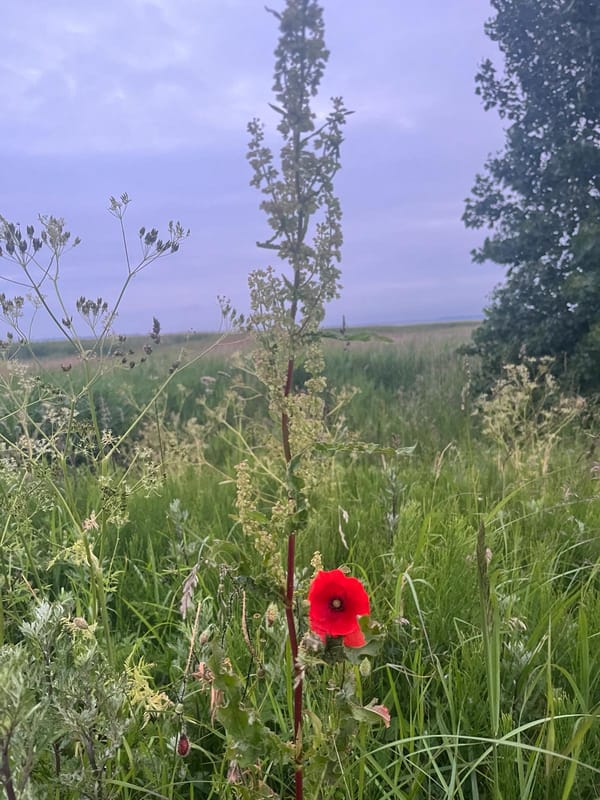
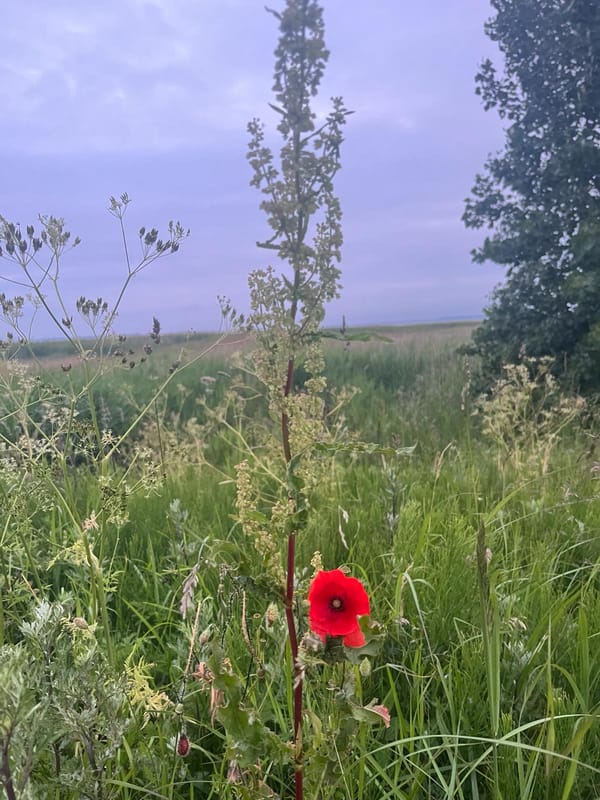
Nature access. The winding pathway between the Bodden and the rapeseed fields. Reed beds at first light — the particular sound of wind in them, different from any reed field in Brandenburg. The Bodden at different hours: mirror-flat at dawn, textured by wind by afternoon, carrying the full moon's light at 19:00 on May 1. The swans — this morning a lone pair on the still water, the main group far away. The ducks rising in formation over the reed beds on Day 37. The wild pigs before dawn. The rapeseed yellow in every direction. The bicycle adding a different layer in Phase 4 — not walking the terrain but moving through it at speed, the body reading the road surface, the field edges, the shift from shelter to open.
Fifteen years of Brandenburg runs underneath all of this as the comparison the body makes without being asked. The Seenland lakes are real. The forest around Müllrose is real. Nature access scored 4 there. Here it scored 4. The body knew the difference on the first morning.
Sensory environment. Sound, smell, light, texture — what the body is bathed in from waking to sleep. The Baltic smell carried inland on a west wind — not sea exactly, more the edge of it. Yesterday morning, in Flower time before nine, the smell of decomposition and spring growth together — the thing the body named without ceremony: the smell of death. You cannot smell from a distance. You have to be inside the thing. Thirty-eight mornings inside this sensory field have done something to the register — sharpened it, or restored what was already there and had been quieter in a landlocked place.
Social environment. Who is in the daily atmosphere. Achim — thirty-eight days of working alongside someone who knows what soil is, who treats the land as a living system, who has been building something here for three years. Ina. The guests moving through. The rhythm of a community that has its own practice, its own language for the work. The social field is part of the environment the body inhabits. It is not incidental to this need — it is one of its dimensions. In Müllrose, the social environment held what it held. Both what was built and what broke.
Built environment. The room. The paths between buildings. The garden layout — where the beds are, where the compost turns, where the Terra Preta accumulates. The kitchen where the vegetables and flowers were taken yesterday morning before the walk. The architecture of daily life here asks something specific of the body and gives something back. This dimension has not been in the matrix. It should be.
The matrix scores Nature access: Müllrose 4, Gut Nisdorf 4. No difference. The note for Müllrose: Lakes, forest, Seenland. Accurate. The Seenland is one of Brandenburg's genuine gifts.
The honest question is not whether the scores are right. It is whether a single row — nature access — is sufficient to hold the Environmental need. Sensory environment, social environment, built environment — three dimensions the matrix did not score. When those are included, the question is no longer about two identical numbers on one criterion. It is about what the body has actually been living inside of for thirty-nine days, and what it would return to.
Nature heals. Not metaphor — what the body has been demonstrating across thirty-nine mornings here. The Bodden, the reed beds, the soil under the hands, the rapeseed in every direction. The question the matrix cannot answer is whether that healing capacity belongs to this specific landscape, or whether it travels. The Seenland lakes around Müllrose are real. The forest is real. The body can receive what nature offers — the question is whether it can receive it there, or whether the wound site quality of the place colours the air before the lungs can use it.
A landscape can be beautiful and also be a wound site. The body registers both. The matrix only scored the landscape.
Day 39b — Phase 6 — Taste — Small Intestine — Diamond — Ecclesiastes
Gut Nisdorf, Mecklenburg-Vorpommern, Baltic Coast
© 2025–2026 Michel Garand | A Pilgrim's Fitness Plan | CC BY-SA 4.0
stewardship@ubec.network