Celtic Tradition — The Thin Places
A Reference Document — The Wisdom Tradition Behind Phase 5
The wisdom tradition behind Phase 5 — Smell — Heart — Sapphire
Gut Nisdorf, Mecklenburg-Vorpommern, Baltic Coast, Germany
What This Tradition Holds
The Celtic Christian and pre-Christian traditions of the British Isles and Atlantic coast of Europe developed, over centuries of living in specific landscapes, a vocabulary for what they noticed about the relationship between place and consciousness. The most precise term in that vocabulary is caol áit — thin place. A place where the membrane between the visible world and whatever lies beneath or beyond it is particularly permeable.
Thin places were not invented by the Celts. They were identified. Standing stones placed at the intersection of ley lines. Springs where the water came up through the rock with an unusual quality of coldness or clarity. Promontories where the land met the sea in a way that seemed to exceed its physical description. The thin places were marked not because they were magical in a theatrical sense but because those who lived with them over time noticed that something was consistently different there — that certain kinds of perception, certain kinds of knowing, arrived more easily in those locations than elsewhere.
The contemporary language for this includes what geobiologists call places of intensified earth energy, what ecopsychologists call restorative environments, what neuroscientists studying the default mode network call conditions that reduce the cognitive load of self-maintenance. These are attempts to describe the same phenomenon from different directions. The Celtic tradition held the phenomenon in the category of place memory — the understanding that the landscape itself carries what has happened in it, and that a sensitive enough instrument — a human body, attentive — can receive it.
The Heart and the Memory of Place
Phase 5 is assigned to the Heart in the TCM framework. The Heart is the sovereign organ — it governs consciousness itself, the quality of presence, the degree to which the person is genuinely inhabiting their own life rather than managing it from a slight distance. Its dysfunction is not anger or grief or fear — those belong to other organs. Its dysfunction is disconnection: the condition of a person who is technically present but not actually there.
The Celtic tradition, through its careful attention to place memory, provides the specific antidote: the practice of being fully arrived in the specific place that is actually present. Not the remembered place, not the imagined future place, not the managed relationship with the place — the actual ground, this smell, this quality of light, this particular intersection of land and water and human attention accumulated over time.
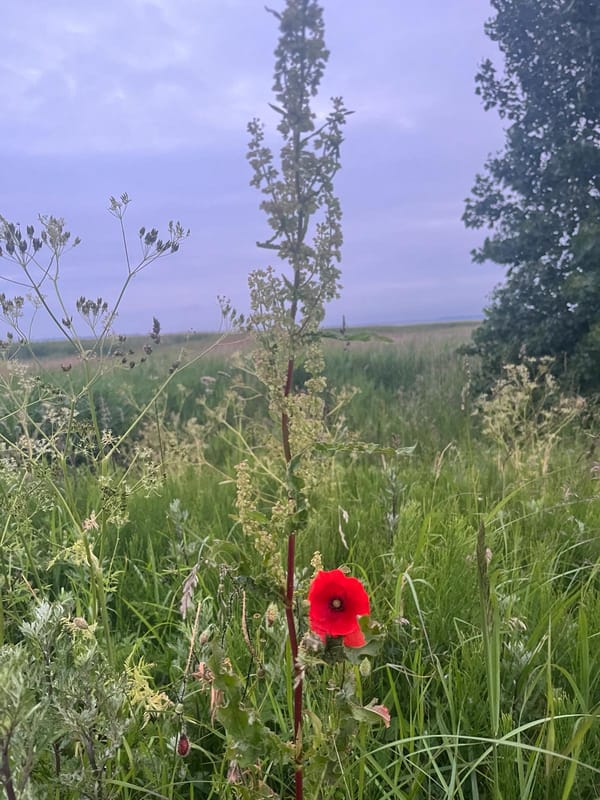
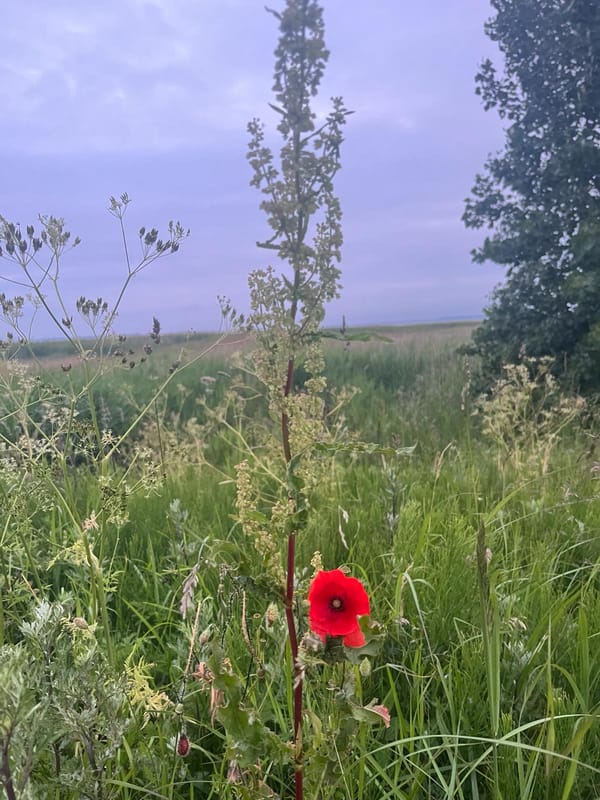
Gut Nisdorf is a thin place in the Celtic sense — not because it has been formally designated as one, but because the quality of what it carries is palpable. The land first documented in 1302 by Ritter Johannes von Nisdorf (Johannes de Ost de Neslestorp), who gave it as a gift to Kloster Neuenkamp. Achim Ecker's thirty years of daily practice in the soil. The Baltic Bodden visible from the property edge. The Bodden itself — the lagoon system that is neither fully sea nor fully land, the Celtic caol áit made geological.
The Heart recognizes this. Long before the mind has assembled the historical account.
Smell — The Sense of Involuntary Memory
The sense of Phase 5 is Smell — the only sense that bypasses the thalamus and routes directly to the limbic system, the brain's oldest structure, the seat of emotion and memory. You do not process a smell and then feel something. The smell arrives already emotional. Already remembered. Already connected to every other time the body encountered that compound.
This is why place memory in the Celtic tradition is always also sensory memory. The thin place is not primarily visible. It is smelled and felt and heard in a particular quality of silence. The monk who returns to the same stone cell for forty years knows the place through his nose before he crosses the threshold — the specific combination of stone moisture and coastal air and decades of incense and human breath that belongs to no other location on earth.
The practitioner at Gut Nisdorf in Week 5 has been in the garden long enough that the smell of the soil — Achim's Terra Preta compost, the herb garden releasing its compounds into the April air — has become part of the body's place vocabulary. Not consciously catalogued. Carried. The Heart receives what the nose brings. The limbic system files it as: here. This is the place. This is the ground.
The Celtic tradition understood this as a spiritual practice — the deliberate cultivation of sensory attention as a pathway to the kind of knowing that does not arrive through analysis. The body knows the thin place through its nose before the mind has assembled the argument for staying.
Sapphire — The Quality of Discernment
The stone of Phase 5 is Sapphire — deep blue, the colour of the sky at the moment just before night, the colour of the sea at its deepest point. In the ancient breastplate tradition, Sapphire is associated with heavenly wisdom, with the capacity to see what is actually true rather than what is wished or feared. Its quality of light is clarifying — not the warm red of Carnelian or the gold of Topaz, but the blue that reduces without diminishing.
The Celtic tradition's particular gift in Phase 5 is discernment — the capacity to know what belongs and what does not. The thin place teaches this by contrast: the person who has spent enough time in a place of genuine presence begins to notice, with increasing precision, what disrupts it. Not moral judgment. The finer instrument of sensing what is consonant with the ground and what is not.
The tribal shadow of Phase 5 is judgment that wounds — discernment that has lost its ground in genuine perception and become the projection of preference. The gift is discernment that liberates — the capacity to know what belongs here, what is real, what the thin place is actually saying beneath the noise of the thinking mind.
The Heart, in Phase 5, is being asked to develop this instrument. Not through effort but through sustained presence in the specific place — through the quality of attention that the Celtic tradition called anamchara, soul friend: the quality of seeing what is actually there, with full acceptance and full clarity, without the softening of wishful thinking or the hardening of defensive judgment.
A Note on the Tradition
The Celtic tradition is used here in its pre-ecclesiastical and early Christian forms — the tradition that paid attention to landscape as a primary spiritual teacher before and alongside the institutional church that later absorbed it. The caol áit is a pre-Christian concept that the Celtic Christian tradition preserved rather than replaced, understanding that what the landscape holds does not require denominational approval to be real.
This document draws from that tradition's core insight — place holds memory, and the attentive body can receive it — without proposing that the practitioner adopt Celtic spirituality as a framework. The framework serves the body. What the body does with it at Gut Nisdorf belongs to the practitioner.
License and Attribution
© 2025–2026 Michel Garand | A Pilgrim's Fitness Plan
Gut Nisdorf, Mecklenburg-Vorpommern, Baltic Coast, Germany
Licensed under Creative Commons Attribution-ShareAlike 4.0 International (CC BY-SA 4.0)
You are free to share and adapt this material for any purpose, including commercially, provided you give appropriate credit, provide a link to the license, indicate if changes were made, and distribute any adaptations under the same license.
This document was developed with assistance from Claude (Anthropic PBC). All strategic decisions, philosophical positions, and personal commitments are those of the author.
Contact: michel@ubec.network
A Pilgrim's Fitness Plan — Gut Nisdorf 2026
Gut Nisdorf, Mecklenburg-Vorpommern — March 2026