Eight Days at Nisdorf — A Gratitude
Day 8 — Departure day to Müllrose, Brandenburg
Gut Nisdorf, Mecklenburg-Vorpommern, Baltic Coast — April 3, 2026
The bus leaves at 08:11. Six hours south — back to Brandenburg, to my daughter Julika, who turns eleven tomorrow. Gut Nisdorf stays behind me — but not far.
I am coming back.
Before I go, I want to stop. Not to evaluate what was. But to name what was given.
Gratitude is an old ritual. Older than the church, older than writing. It belongs to the earliest practices of humanity — the naming of what was received before moving on. The hunters who touched the ground before departure. The pilgrims who picked up the stone from the path before putting it back down. Not sentiment. Not courtesy. An act of precision: this I received, from this place, from these people, in this time.
To say gratitude without naming what was received is to say nothing. That is politeness — useful, but empty.
I am trying to do something else here: to name the concrete. What this place gave me in eight days. What I carry with me when the bus leaves.
On the first evening I gave Ina a candle — not Achim. I didn't know exactly why at the time. Now I do.
Ina holds the human threshold of this place. Not loudly, not with programme. But every place that truly lives — that is more than buildings and fields — needs someone who holds this quality of attention. Quiet, precise, reliable. You don't recognise this person immediately. You feel them.
Gratitude for the invisible is the hardest kind — because you have to name what withdraws from direct view. I'll try anyway: Ina gave me the feeling that my presence here was not merely tolerated, but welcome. That is not a small gift for someone who has just burned a bridge behind them.
Achim showed me how to read the ground.
Not with words first — with hands, with body weight, with the rhythm of work. Terra Preta is not a project. It is an attitude: that what has been impoverished can become fruitful again if treated correctly. The soil as a living system — not as surface, not as resource. As partner.
I worked alongside him without talking too much. That was right.
The old ritual of gratitude says: name what you learned — not what you already knew, but what arrived newly. What arrived newly in these eight days, through Achim's hands and his silence: that one serves a place best by listening to it before acting. That sounds simple. It is hard. I am still learning it.
The community at Gut Nisdorf invited me into their weekly circle on the fifth evening.
I was new. I listened more than I spoke. That was the right proportion.
The ritual of gratitude knows this silence. The old forms — sitting in a circle, naming what was — do not require you to say much. They require you to be present. Fully present. Not with part of your mind already on the next step.
For this invitation — and for the patience of letting a stranger simply be there — I carry genuine gratitude southward.
What this place gave the body:
Morning exercises, daily. The body heavier than expected at the start. Now — lighter. Not strong. But more mobile. Ready for more.
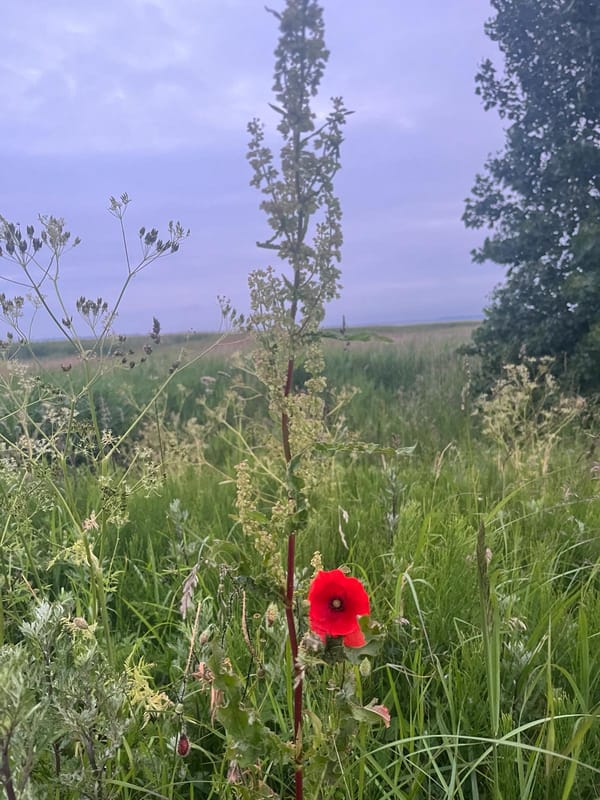
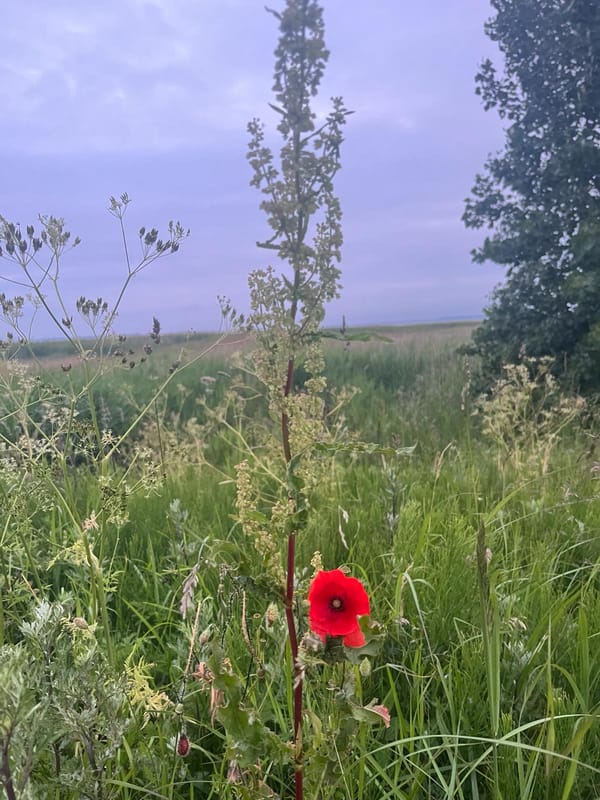
Sunrises I had not planned for. The Baltic sky as its own teacher — it does not ask whether you are ready. It appears.
The Paschal full moonlight, midnight between April 1 and 2. I stood in it. No word is sufficient here — so I leave it at the naming: I stood in it, and it was enough.
The ancient rituals of gratitude knew this moment — the moment where what was received is so large that language briefly pauses. The pausing is itself an act of recognition.
Nisdorf is not a predetermined sacred place. It is a place that has become one through the quality of human attention over millennia. Five thousand years of Baltic coast. Ritter Johannes von Nisdorf (Johannes de Ost de Neslestorp), 1302. Achim's hands in the ground for three years. Ina's quiet precision. The community that sits in a circle week after week.
The ritual of gratitude recognises this connection: what was received does not come from nothing. It comes from the long chain of those who paid attention before us. To perceive a place, to truly see it — that is already a form of thanks. Not only to the people who live here now. To all who have held this ground.
Tomorrow is Julika's birthday. I travel as a father — that is the compass for the next two days.
Then I come back to Nisdorf. The twelve weeks are not over. They have just begun.
To Achim, Ina and the community of Gut Nisdorf: I name what was received. That is the oldest thing one can do before moving on.
Thank you.
© 2025–2026 Michel Garand | A Pilgrim's Fitness Plan
Gut Nisdorf, Mecklenburg-Vorpommern, Baltic Coast, Germany
Licensed under Creative Commons Attribution-ShareAlike 4.0 International (CC BY-SA 4.0)
This document was developed with assistance from Claude (Anthropic PBC). All strategic decisions, philosophical positions, and personal commitments are those of the author.
Contact: stewardship@ubec.network
A Pilgrim's Fitness Plan — Gut Nisdorf 2026
Gut Nisdorf, Mecklenburg-Vorpommern — April 2026